

Updated: 14-Oct-2026
See Frank Whittle, Power Jets, BTH, GE.
-In 1928, while a cadet at Cranwell, Whittle wrote a thesis on the possibility of jet propulsion. Eighteen months later, he conceived the idea of using gas turbines for such propulsion.
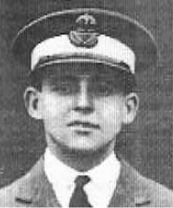
“Whittle at Cranwell”

“From Whittle's patent”
-The first patent dates from 1930 and was numbered 347206.
-He proposed his plans to the British Air Ministry, but he did not receive much attention.
So in 1935 he partnered with Messrs. Williams and Tinling, forming Power Jets Ltd. in 1936.
While the company was being established, the bankers Kalk and Partners financed it, using British Thomson Houston Ltd. (BTH) to prepare the design and later build an engine according to Whittle's specifications.
The combustion chamber proved to be the most difficult part, requiring Whittle to enlist the help of Laidlaw, Drew and Co. to design and manufacture combustion chambers. It was the first Whittle Unit (WU).
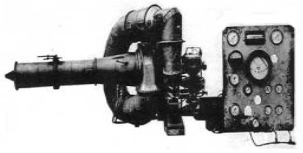
“Whittle's First Test”
The complete engine was tested in 1937.
The compressor's performance was sufficient, but the combustion chamber problems persisted, only being partially resolved.
At that point, the Ministry expressed interest in contracting with the company for future experiments. BTH rebuilt the engine. It was the second Whittle Unit (WU).
-For more details, see the Power Jets chapter.
-There was a third WU, tested in 1941.
-By this time, Frank Whittle was already a captain.

“Frank Whittle, Captain”
-All the vicissitudes, the engines built, and their licensing to the Americans are known from the aforementioned chapter.
-It leaves us to discuss finally other little-known projects of this English pioneer of jet propulsion.
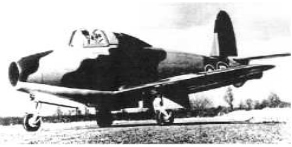
“Gloster E28/39”
-It was actually in the summer of 1939 that Power Jets received the order to prepare an engine for flight testing.
-Gloster was preparing the airframe for the E28/39 aircraft.
-The engine, built by BTH, became known as the W.1, and on May 15th, the first flight of an English jet-powered aircraft took place.
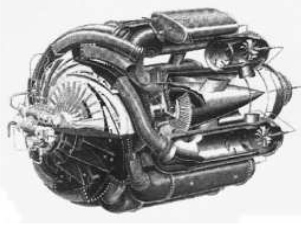
“W.1 Engine”
-We know that the Germans had flown this jet propulsion system shortly before on the Heinkel He-178 aircraft.
-For his work, Frank Whittle was knighted, an Brittish title bestowed upon prominent figures in that country.
-We will now mention the turboprop engine tested by Power Jets, designed for 250 HP.
-It did not attract the attention of authorities or potential customers, although it is said to have been a predecessor of the PT6, so prevalent today.

“Power Jets Turboprop”
-During this period of great productivity, a turbofan design was developed, almost identical to those we have today.

“Power Jets Turbofan”
-Another Whittle patent was an “Augmentor,” or thrust enhancer, essentially a turbofan like the GE engines of today. That is, a turbojet whose exhaust gases are directed to a second, larger-diameter turbine, located further back and shrouded, acting as a turbofan.
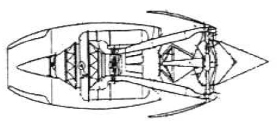
“Turbofan Augmentor nº 3”
-Another Whittle design was a compound engine. A central turbine produced enough exhaust gases for two other turbines to drive two induced fans.

“Double Turbofan”
-Another design is that of an engine with thrust enhancers or turbofans mounted on the turbine blades and a standard fan at the inlet.

“Turbofan with Boosters”
-One of Whittle's projects involved combining several engines whose jets impinged on a rear turbine to drive a front fan.

“Multiple-Engine Turbofan”
-In practical terms, the constantly evolving experimental WU engines were developed, as we see today.
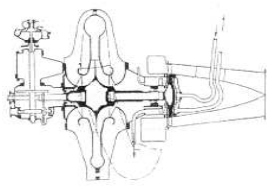
“First WU Project”

“Second WU Prototype”

“Third WU Prototype”
-Next, we will show the first real engines with satisfactory results, namely the W.1, W.1A, and W.2B.
-The first two were from Power Jets (see) and the third was made by Rover (and Power Jets, of course).
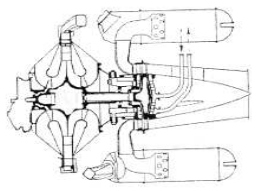
“Power Jets W.1”
-In this model, we can still see the turbine disc being cooled by water.
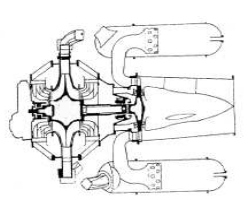
“Power Jets W.1A”
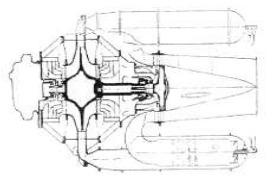
“Power Jets-Rover W.2B”
-Several tests were carried out with the W.2B/23, including flight tests on a Wellington bomber. Tests began in 1942.
- Tests were conducted with afterburners and the injection of products to increase power.
- These engines would lead to the next evolution: the W2/500, W2/700, and W2/850. Other models are also described in the Power Jets chapter.
- Due to delays and other problems, and with the urgency of the global war, it was decided to transfer production to the experienced—and more well-resourced—Rolls-Royce.
- There, the engine would be renamed the “Welland”. See the Rolls-Royce chapter.
-The W2/700, perhaps Whittle's last design with reverse combustion chambers, is shown below.

“Nice photo of the W2/700”
-According to information found online about Frank Whittle, when he was preparing the engine to power the Meteor and working for Rover and Rolls-Royce, he stayed in Barnoldswick with other engineers to develop the W2.
-The result was already in line with what would become the Nene and Derwent engines.


“The W2 for the Meteor”
From Appendix 12: Frank Whittle was the creator of the first British turbine to fly in an aircraft (see main text).
-The first installation was on a small Gloster. But now we have found some accounts of installations carried out by Whittle himself.
-First, we have the layout of his first single-chamber combustion turbine. It had the layout of a seaplane.
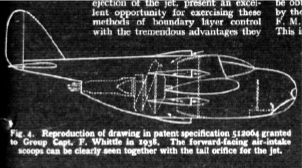
“Aircraft project design by Whittle”

“We see that the engine is the one in this photo.”
-As his jet engines improved and changed their shape to a more rational one, they achieved power levels that made the project viable.
-But now for a smaller aircraft like the Gloster.
-Another project attributed to him is a kind of multi-engine flying wing.

It is very likely that this was also Frank's.
-However, the author of this work is no longer certain about the next project, although it comes from the same source.

“Called the Stratoplane.”
-A project by pioneer Frank Whittle not yet shown. Now in color.
-It's actually a jet engine. A piston engine drives the compressor. The air is reheated and sent to a turbine that powers a fan or ducted propeller.

"Frank Whittle's Project 9 Jet Engine Patent"
Motores de WHITTLE
Model: W-1
Arquitecture:
Compressor/s:
Combustion chambers:
Turbines:
Power / Thrust: / ---
Weight: