

Updated: 04-Feb-2026
Walter Zarges, the Stuttgart-based engineer who built Wernher von Braun's prototypes, is known as the one shown.
-The engine shown was from the group tested in 1933 and on Borkum Island in the winter of 1934.
-With only 300 kgf of thrust (660 lbf), it was the engine installed on the A-2 rocket (remember that the V-2 was an A-4).
-Therefore smaller, but if we compare this engine with the V-2 rocket's, the design is identical. It also operates on liquid oxygen and alcohol.

“Walter Zarges Engine”
-Even all the fittings and pipes would serve as a guide for the engine manufactured later.
-All the tubes leading to the base of the nozzle carry fuel that circulates between the walls to cool the engine. Photo taken at NASM.
From Appendix A3/6: A metallurgical company established in Stuttgart in 1934 manufactured the A-2 engine for Von Braun (see), who was already working for the German government (German Army Ordnance).
-The engine they produced that year was the A-2 mentioned in the main text, of which we had no illustration until we located one at the Smithsonian Museum, donated by the company itself.
-It turns out that in 1972 they made copies at the new factory in Murnau, West Germany. One of those copies ended up at this NASM museum.
-The A-2 was a precursor to the V-2 ballistic missile engine. And as we can see, it resembles the engines of other later missile models, such as the smaller A-5.
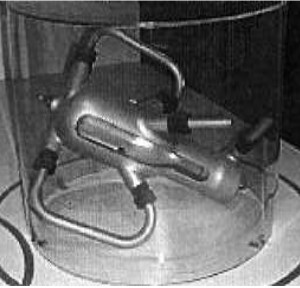
“A-2 Engine”
-It was used on the Max and Moritz missiles, it was liquid-fueled: liquid oxygen and ethyl alcohol, producing 300 kgf of thrust for 60 seconds.
Motores de WALTER ZARGES
Model: A-2
Arquitecture:
Chambers:
Fuels:
Feed System:
Ignition:
Thrust:
Weight: