

Updated: 02-Nov-2026
The Wisconsin Motor Mfg. Co. of Milwaukee, WI, a manufacturer of industrial, automotive, and truck engines, had a division called Wisconsin Aeroplane Motors.
-It produced water-cooled, inline, 6-cylinder engines rated at 1400 rpm.
-In reality, it gave 148 hp at that speed, with a total displacement of 766 cubic inches.

“Wisconsin, 140 HP”
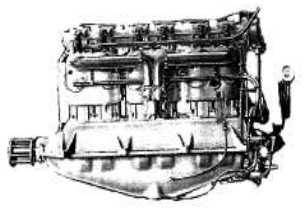
“Wisconsin, 140 HP, seen from the other side”

“Wisconsin 140 HP, rear view”
-In fact, the 140 hp was achieved at 1300 rpm. The compression ratio was only 4.55:1.

“Wisconsin V-12”
-The V-12's displacement was exactly double that of the inline-six engine, a total of 1532 cu in., so it is assumed to have been an engine based on two blocks of that engine.
-It delivered 250 HP at 1200 rpm and was water-cooled as well. It had overhead camshafts driven by a gear train.
-In the below view, we see the four magnetos of the ignition system.
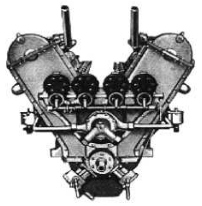
“Rear view of the V-12”
-If the 6-cylinder weighed 600 lbs with an additional 100 lbs of water, the V-12 weighed 1,000 lbs dry, without water or oil.

“Wisconsin APU”
-Finally, they began building engines for ground support units such as APUs, installed on A-1 trailers with wheels that could be towed by other vehicles.
-Among these engines, typical of the 1940s, 50s, and 60s, the MVE4D and MVF4D models stand out.
-Both are four-cylinder engines with a 90° angle between them, which results in a slightly rough idle.
-This isn't a problem, since once the engine is started and controlled by a speed governor, it stabilizes at a high RPM.
-It's worth reiterating that every aircraft mechanic should be familiar with the engines of the ground equipment they use in their work.
-The author of this work has used equipment with Wisconsin engines, but more modern ones installed in APUs and APPs.
-That's why it's interesting to learn about the deeper history of this brand.


“Wisconsin inline six-cylinder” (PiP)


“Three diagrams of Wisconsin engines” (PiP)
-The cylinders with the valve springs are covered, although the mechanism is the same as the previous inline engine and indicates a period from the 1910s-20s.
-This system is maintained in the V-engine.

“Diagram of the Wisconsin V-12 engine”
From Appendix 12: Two new illustrations of the V-12 engine. The one of the complete engine does not appear in the main text. Obtained from a pre-WWII German publication, “Flugsport.”

“Wisconsin V-12” (PiP-Flu)
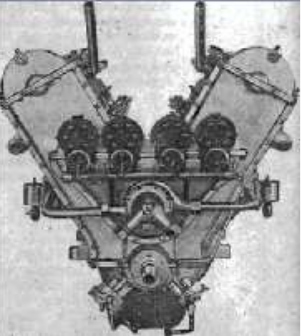
“Rear view of the V-12” (PiP-Flu)
-The engine's design is obscured from the rear by the valve train housings.
Motores de WISCONSIN AEROPLANE MOTORS
Model: 6-cyl. inline, 140hp
Arquitecture:
Cooling:
Total Displacement:
Bore / Stroke: x
Power:
Weight:
Model: Comet
Arquitecture:
Cooling:
Total Displacement:
Bore / Stroke: x
Power:
Weight:
Model: V-12, 250hP
Arquitecture:
Cooling:
Total Displacement:
Bore / Stroke:
Power:
Weight: