

Updated: 17-Oct-2026
Wifredo Ricart was a prominent industrial engineer born in Barcelona with a distinguished career in the automotive and aeronautical industries.
-He was involved in numerous initiatives for the development of aviation in his city. He was also involved in automobile manufacturing, establishing his own companies and collaborating with others.
-Notable companies include Ricart, Ricart y Perez, and Ricart-España. He worked in Italy at Alfa Romeo, where he was involved in sports cars and aircraft engines. He held several patents. Upon returning to Spain, he designed the well-known Pegaso Z-102 cars, among others.


“Ricart Factory and Sports Car”
-See also Alfa Romeo. The refinement of Ricart's engines in the 1930s demonstrates a remarkable capacity for design, creating beautiful, practical, and modern vehicles.

“Ricart-Perez y Ricart, Automotive”
-He was a designer and manufacturer of modern and beautiful engines used in motorsports and boating.

“Canoe with a Ricart engine. Port of Barcelona”

“Wifredo in dark clothing in front of one of his racing cars”
-And below, a test bench where they tested the engines he manufactured.

“Ricart Test Bench”
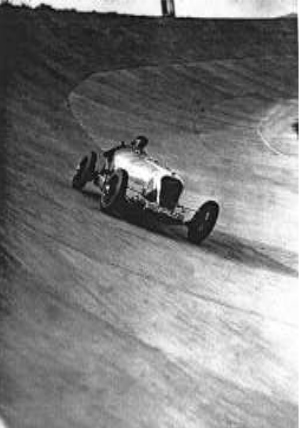
“In Competition at Terramar-Sitges”
-During his time in Italy, at Alfa Romeo, he designed the brand's sports cars, such as the famous 512 of 1939. And also the 162.

“Wifredo Ricart in his 162 sports car”

“Wifredo's 1940 Alfa Romeo 512”
-The 162's engine was a 16-cylinder V engine with 500 hp, while the 512's was a 12-cylinder horizontally-opposed engine with 336 hp.
-During his time at Alfa Romeo, he served as Technical Director in the design and construction of different types of aircraft engines.
-Late 1930s and mid-1940s.
-His registered aeronautical patents also demonstrate a high level of technical skill.

“Joint Alfa Romeo/W. Ricart Patent”
-Registered under Italian number 384708 in 1941, it concerns the transmission of a supercharger.

“W. Ricart Spanish Patent of 1935”
-The above patent concerns a reduction gearbox and input for two crankshafts with output for two contra-rotating propellers.
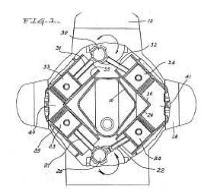
W. Ricart's 1930 Patent

1934 Patent, Super-Diesel Engine
- It would be manufactured at Hispano Suiza under license from W. Ricart. It featured a compact design with opposed pistons and was based on the previous twin-cylinder engine concept with a complex connecting rod.
- But he also patented and designed a virtually unknown aircraft engine, the Alfa Romeo 101-RC37/87.
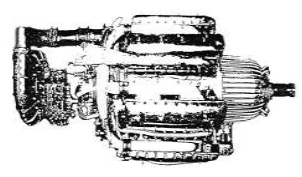
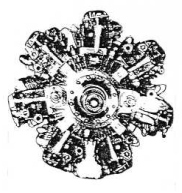
"Alfa Romeo 101 RC37/87 Engine"
- The 101 was designed by Wifredo Ricart in 1942. It had a displacement of 50.25 liters, with a nominal power of 2000 hp and a peak power of 2300 hp.
-It had 28 cylinders in four rows of 7 cylinders each and was supercharged.

“Supercharger multiplier diagram”
-Many of the patents are held by both Wifredo Ricart and Alfa Romeo.
-After the conflicts of the 1940s, he returned to Barcelona where he founded the design and standardization company CETA in Madrid (headquarters of the INI) and Barcelona. Here he continued his fruitful career, notable for his modular engines with unique mechanics.
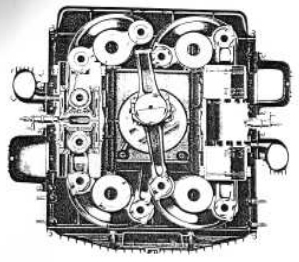

“Ceta Z cross-section drawing and diagram”
-Intended for land or marine propulsion, it does not appear suitable for aviation.

“View of Wifredo Ricart's Ceta Z”
-This engine was modular and could have two, four, six, eight... cylinders.
-At that time, he was asked to relaunch truck production at the former Hispano Suiza, nationalized as ENASA and better known as “Pegaso.”
-There, he put the finishing touch on his career with the spectacular Z-102 sports cars, with beautiful lines (for the 1950s), but in a difficult context in Spain after the Civil War, which perhaps prevented a successful career.

“Pegaso Z-102 from 1954”
-It is maintained that the mechanics of these W. Ricart cars were not matched by Ferrari until eight years later.
From Appendix 6: During his time at Alfa Romeo, he also designed a four-cylinder piston engine. which is clearly different from those shown in the main text.
-This is the 1100, a reference found recently that is not compatible with those shown and mentioned there.
-Its 120 hp power output also makes it different from all of them.
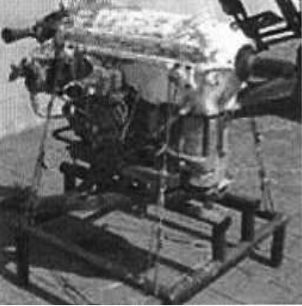
“Alfa Romeo 1100, 120 hp”
-Information obtained from the Museum of Aviation.
-Not from Alfa Romeo, as the name of this Spanish designer, who headed the brand's projects and design department during WWII, isn't even mentioned.
-The fabulous four-row radial engine, which we knew as the 101, is also identified as the 1101.
-He also designed another prototype, the 6C-2000 Gazella, about which there is no further information at the moment.
-From the Wifredo Ricart family archive, housed at the Museum of Science and Technology of Catalonia in Terrassa, a better photograph of the colossal Alfa Romeo 1101 engine has been found.

“Wifredo Ricart's 1101 Engine”
-It remained unknown for a long time. It had 28 liquid-cooled cylinders.
-It had four-cylinder blocks around the central crankcase. A total of seven blocks in a radial configuration.
-It produced 2500/3000 hp with fuel injection. There were several prototypes (around 20) but they were destroyed in 1943 by resistance attacks.
-We see a large single-stage mechanical supercharger. It is known that another version with a double-stage supercharger and intercooler was being prepared.
Motores de WIFREDO RICART
Model: AR-1100 (AR-100), 4 cyl. inv
Arquitecture:
Cooling:
Total Displacement:
Bore / Stroke: x
Power:
Weight:
Model: AR-1101 (AR-101), 28 cyl.
Arquitecture:
Cooling:
Total Displacement:
Bore / Stroke: x
Power:
Weight: