

Updated: 09-Oct-2026
In late 1941, Westinghouse had extensive experience with steam turbines when it received a contract from the US Navy to begin work on gas turbines for aircraft.

“L9XB-2B”
-The L9XB model is known as the first project completed. However, the 19A and 19B were the first operational models, the latter popularly known as the “Yankee.”
-At the same time, a smaller model, the Baby or 9.5A, was being developed for missiles, or guided bombs, as they were then known, and the 9.5B for aircraft support.

“Westinghouse 9.5A”

“Westinghouse 9.5B”
-The 9.5A had a thrust of 260 lbf, while the 9.5B had a thrust of 275 lbf.
-The J-30s were the 19XB, with a thrust of approximately 650-730 kgf.
-The 19A and 19B were derived from these, specifically from the J-30WE-20.
-The engines developed by Westinghouse were those that received the military designations J-30, J-32, J-34, J-40, J-46, J-54, and J-81.
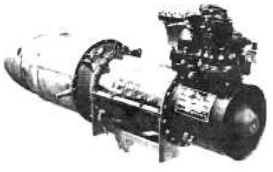
“Baby 9.5B”
-The J-32s were precisely the 9.5A and 9.5B, or the “Babys,” with 275 lbf of thrust. They are expendable engines.

“Comparison between the 19B and the 9.5B”
- The 19B can be considered the first fully operational turbojet engine designed in the USA and was completed in 1943.
- This engine was tested on the ground and in flight under the fuselage of a Corsair before being permanently installed on the twinjet McDonnell FD-1 Phantom, which carried two 19B “Yankee” turbojets on the wing and fuselage roots.

“19A Yankee”
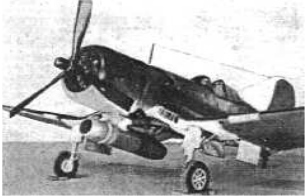
“Westinghouse 19B Yankee fitted under a Corsair aircraft”

“Yankee 19B”
- All Westinghouse turbojets have an axial compressor. The 9.5B Baby, with its very small compressor diameter, ran at 34,000 rpm.
However, the 19B Yankee ran at 18,000 rpm. The diameter increased from 9.5 to 19 inches, a reference point for the early engines.

“J-34.WE-32”

“J-34-WE-34”
From the experience gained with the earlier engines came the J-34, from which variants such as the WE-32, the 3250 lb WE-34, the WE-48 of the same power, etc., were derived.

“J-34-WE-34”

“J-34-WE-48”
-The WE-48 was from the 1950s and was the most commonly used engine on aircraft of that era as a booster or auxiliary engine.
-It was also used as the main engine in some cases, such as in the XF-85 Goblin fighter, which was carried as a parasite aircraft on the B-36.

“J-34 Jet-Pack”
- It could be mounted on the fuselage (as in the Boxcar and Fairchild C-119, although the photo shown is of an aircraft of that type with the J-34s under the wings).
- It was offered as a jetpack, faired and with a unique feature: front-mounted doors that closed the air intake when not in use.
- When installed on the Fairchild C-119 freighter, the engine was a J-3402 Jetpack, and the aircraft became known as the STOL-Master.
- The J-34s were also seen on the Neptune and the MacDonald Banshee F2H. And on the Douglas Skynight F3D. And on the Stiletto, Sea Dart, and Skyrocket, etc.

“Westinghouse J-36”
- The J-36 was a direct derivative of the J-19A and 19B.


“J-40, WE-6 y WE-8”
-The J-40s were larger and had thrusts of 7,500 lbf dry in the WE-6 and up to 10,000 lbf with afterburner in the WE-8.
-The J-46 that gave 2,175 kgf of thrust, was installed on the Cutlass. This engine was certified in 1952, and it replaced the J-34. It was similar in architecture.
-In 1953, a collaboration agreement was signed with Rolls-Royce, resulting in the design of the XJ-54, which turned out to be a scaled-down Avon, and the XJ-81, a reproduction of the Soar for RPVs. See Rolls-Royce.
-The J-81 Soar would be seen in the Red/Blue Rapier.
-Westinghouse Electric Corp. had already made designs Premonitory designs like the turboprop (early 1940s) "Ducted Propeller," known today as a turbofan or high-bypass turbojet.
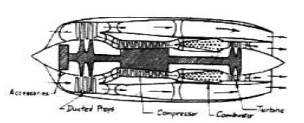
“Westinghouse Turbofan Design”
-Another design from the same period was a turboprop with two shafts: one with a turbine to drive the compressor and the other turbine with the shaft that, through a reduction gear, drove the propeller.

“Turboprop Project”
-Another more interesting project from that time was the compound turbine engine.
-A turboprop with a free turbine, generating gas, and in which its compressor received air from the main unit through an intercooler.
-The main unit had the propeller shaft.
-The combustion chamber of the free turbine, after passing through it, sends the gases to a reheater where a second combustion occurs.
-These gases drive the turbine of the main engine.

“Compound Turboprop”
-We assume that due to its complexity, we haven't seen the completed project. It was an engineering exercise.
From Appendix 6: A diagram of the XB engine mentioned in the main text is available. It is, in fact, the XB-19, due to its 19 inches in diameter and also like J-30.
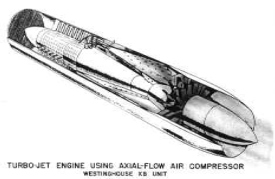
"Westinghouse 19-XB"

“Westinghouse J-46”
-In summary, In 1953, the reactors of this brand were:
-J30-WE-20, 1550 lbf at 17000 rpm.
-J34-WE-36, 3400 lbf at 12500 rpm.
-J40-WE-6, 7500 lbf at 7600 rpm.
-J40-WE-8, 10500 lbf at 7600 rpm.
-J46-WE-8, 6000 lbf at ?.
-J54-WE-2, 6500 lbf. (T54-WE-2)
-They were long-bodied turbojets with afterburner and were used on aircraft of the same design.
-See the Cutlass, Sea Dart, FH Phantom, Banshee, Demon, Skyray, etc.

“Westinghouse J54 (T54)”
-In its 1940s presentation, Westinghouse showcased the small “9.5” model, the number referring to the engine's diameter.

“The 9.5 initially weighed 145 lbs.”
-The thrust was 275 lbF, achieved (and I quote verbatim) “when its turbine rotates 34,000 times per minute.”
-The engineers said it could be used as a power source for small aircraft, as a booster, for supercharging cabins, wing de-icing, powering helicopters, etc.
-We have new views of Westinghouse engines as they are in the Hagley Museum and its documentation center.

“A 19A Yankee, faired”
-The 19As were auxiliary engines, fitted to piston-engine aircraft to aid takeoff, as was the case with the Fairchild.

“The J-34 with afterburner”

"Westinghouse J40"
-Turbojet engines of this brand, already discussed in the main text, and other additions are included.
The intention is to have them available when the main text and the Addenda are reunited into a single document, selecting the most appropriate options.

“24-C Yankee”
-They were used in early Navy fighters such as the Phantom, Banshee, etc.

“Westinghouse XP-85”
-They had a minimal frontal area and were capable of launching an aircraft at over 600 miles per hour in its time. Early 1950s.

“Westinghouse J-40”
-Considering that the best piston-engine fighters of late WWII reached 2,000 HP, in just a few years, with the advent of turbojets, power increased to 5,000 HP or the equivalent of 25,000 HP in the J-40, shown here.
-And only fewer years had passed than the fingers of one hand!
Motores de WESTINGHOUSE
Model: 19XB
Arquitecture:
Compressor/s:
Combustion chambers:
Turbines:
Power / Thrust: / ---
Weight:
Model: 24C
Arquitecture:
Compressor/s:
Combustion chambers:
Turbines:
Power / Thrust: / ---
Weight:
Model: 40E
Arquitecture:
Compressor/s:
Combustion chambers:
Turbines:
Power / Thrust: / ---
Weight:
Model: J-30 (L-9XB)
Arquitecture:
Compressor/s:
Combustion chambers:
Turbines:
Power / Thrust: / ---
Weight:
Model: J-30-WE-, (19A y 19B) “Yankee”
Arquitecture:
Compressor/s:
Combustion chambers:
Turbines:
Power / Thrust:
Weight:
Model: J-32 (9.5A y 9.5B) “Baby”
Arquitecture:
Compressor/s:
Combustion chambers:
Turbines:
Power / Thrust: / ---
Weight:
Model: J-34
Arquitecture:
Compressor/s:
Combustion chambers:
Turbines:
Power / Thrust: / ---
Weight:
Model: J-36
Arquitecture:
Compressor/s:
Combustion chambers:
Turbines:
Power / Thrust: / ---
Weight:
Model: J-40
Arquitecture:
Compressor/s:
Combustion chambers:
Turbines:
Power / Thrust:
Weight:
Model: J-43
Arquitecture:
Compressor/s:
Combustion chambers:
Turbines:
Power / Thrust: / ---
Weight:
Model: J-45
Arquitecture:
Compressor/s:
Combustion chambers:
Turbines:
Power / Thrust: / ---
Weight:
Model: J-46
Arquitecture:
Compressor/s:
Combustion chambers:
Turbines:
Power / Thrust: / ---
Weight:
Model: J-50
Arquitecture:
Compressor/s:
Combustion chambers:
Turbines:
Power / Thrust: / ---
Weight:
Model: J-54
Arquitecture:
Compressor/s:
Combustion chambers:
Turbines:
Power / Thrust: / ---
Weight:
Model: J-81
Arquitecture:
Compressor/s:
Combustion chambers:
Turbines:
Power / Thrust: / ---
Weight:
Model: T-30
Arquitecture:
Compressor/s:
Combustion chambers:
Turbines:
Power / Thrust: / ---
Weight:
Model: T-70
Arquitecture:
Compressor/s:
Combustion chambers:
Turbines:
Power / Thrust: / ---
Weight: